

A dead car battery is one of those problems that never seems to happen at a convenient time. It can happen in a supermarket parking lot, on a cold morning before work, or miles away from home. The problem is that not every pair of jumper cables is capable of delivering enough current to start a large engine reliably. For most drivers, I would prioritize 4-gauge or 2-gauge cables around 16–20 feet long. Owners of large trucks, diesel vehicles, RVs, or commercial vehicles should consider going thicker, such as 1-gauge or 0-gauge, particularly when long cable lengths are required. Lower AWG numbers indicate thicker conductors. After comparing the specifications, intended use, cable length, gauge, clamp design, portability, and price positioning, these are the Best 5 Jumper Cables :
| Rank | Jumper Cable | Gauge / Length | Best For | Price Position* |
|---|---|---|---|---|
| 1 | TOPDC 2-Gauge Heavy-Duty | 2 AWG / 20 ft | Best overall | Mid-range |
| 2 | TOPDC 1-Gauge | 1 AWG / 25 ft | Trucks & large vehicles | Premium |
| 3 | CARTMAN 1-Gauge | 1 AWG / 20 ft | High-current applications | Premium |
| 4 | EPAuto 4-Gauge | 4 AWG / 20 ft | Cars & SUVs | Value |
| 5 | CARTMAN 4-Gauge | 4 AWG / 20 ft | Everyday drivers | Value/Mid-range |
*Jumper-cable prices fluctuate considerably, so check the current Amazon listing before purchasing.
1. TOPDC 2-Gauge 20-Foot Heavy-Duty Jumper Cables — Best Overall
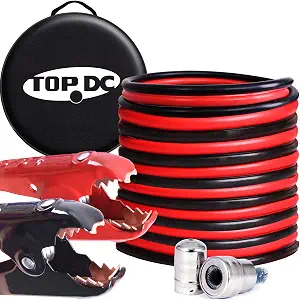
Why I Recommend It
For the average driver who wants something considerably more capable than a cheap emergency cable, 2-gauge cables with a 20-foot reach are an excellent middle ground.
TOPDC’s current heavy-duty range positions its 2-gauge, 20-foot cable for SUVs, pickups, larger vehicles and emergency roadside use. The company also lists 2-gauge/20-foot as its recommended all-around configuration.
Key Features
- 2-gauge heavy-duty construction
- Approximately 20-foot reach
- Designed for cars, SUVs and trucks
- Strong battery clamps
- Long enough for difficult vehicle positioning
- Designed for emergency jump-start situations
- Available in configurations supporting 12V/24V applications
Benefits
The biggest advantage is balance.
A 20-foot cable gives you considerably more freedom when the donor vehicle cannot park directly nose-to-nose with the disabled vehicle. At the same time, 2-gauge wire provides substantially more current-carrying capability than thin emergency cables.
This is particularly useful for:
- Full-size SUVs
- Pickup trucks
- Larger gasoline engines
- Drivers who frequently travel long distances
- Roadside emergency kits
- DIY mechanics
Long cables create more resistance, so using sufficiently thick conductors becomes increasingly important.
Pros
- Excellent balance of gauge and length
- Better suited to large vehicles than thin cables
- 20 feet gives excellent positioning flexibility
- Strong emergency-roadside choice
- More future-proof than buying very thin cables
Cons
- Heavier and bulkier than 6- or 8-gauge cables
- More expensive than basic emergency cables
- May be excessive for very small engines
Who Is It Best For?
Best jumper cables for SUVs, pickups and drivers who want one dependable set for multiple vehicles.
Why They’re Worth the Price
If you’re buying jumper cables to keep for years rather than simply looking for the cheapest possible solution, spending more on an appropriately thick cable can make sense.
Check the latest price and availability now before stock runs out
2. TOPDC 1-Gauge 25-Foot Jumper Cables — Best for Trucks and Large Vehicles
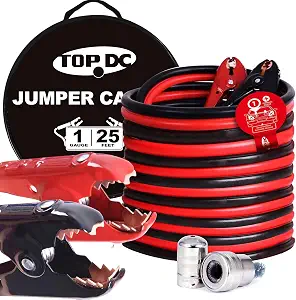
If your priority is maximum reach and heavy-duty capability, the TOPDC 1-gauge 25-foot configuration is one of the more serious options in this category.
Current listings show 1-gauge/25-foot versions and configurations reaching even longer lengths, while TOPDC describes its heavier cables as intended for trucks, SUVs and demanding applications.
Key Features
- 1-gauge conductor
- 25-foot length
- Heavy-duty clamps
- Carrying/storage bag on listed configurations
- Long-distance connection capability
- Available in different heavy-duty configurations
Benefits
The 25-foot length can be extremely useful in real roadside situations.
Imagine a vehicle with a dead battery parked awkwardly against a curb, backed into a narrow parking space, or positioned where another vehicle cannot get directly in front.
A short 8- or 10-foot cable may simply not reach.
The 25-foot TOPDC gives you significantly more positioning freedom.
The 1-gauge construction is also appropriate for drivers who regularly deal with larger engines and demanding starting conditions.
Pros
- Very long 25-foot reach
- Thick 1-gauge construction
- Excellent for trucks and SUVs
- Useful for roadside assistance
- Carrying bag helps with storage
Cons
- Heavy
- Takes more trunk space
- More cable than most compact-car owners need
- Long cables require careful storage to prevent tangling
Who Is It Best For?
Best jumper cables for trucks, large SUVs, RVs, work vehicles and drivers who want maximum reach.
For diesel engines and very large vehicles, thicker cables are generally preferable. Harbor Freight’s current guidance recommends 1-gauge or thicker for diesel engines and engines larger than eight cylinders.
Why They’re Worth the Price
This is the type of jumper cable you buy because you don’t want to discover that your emergency cable is too short or too thin when your battery is already dead.
Check the latest price and availability now before stock runs out
3. CARTMAN 1-Gauge 20-Foot 800A Jumper Cables — Best Heavy-Duty CARTMAN Option
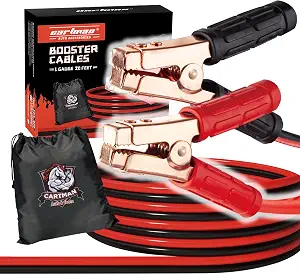
CARTMAN is another well-known name in automotive emergency equipment, and its 1-gauge/20-foot configuration is aimed at drivers who want substantial cable capacity without moving all the way to an extremely long 25- or 30-foot cable.
Current listings show a 1-gauge, 20-foot version rated at 800A, alongside 2-gauge and 4-gauge alternatives.
Key Features
- 1-gauge construction
- 20-foot length
- 800A configuration
- Insulated anti-rust clamps
- Designed for full-size cars, vans and pickups
- Tangle-resistant PVC jacket
Benefits
The combination of 1-gauge + 20 feet makes this a compelling choice when starting performance is more important than minimizing storage space.
The insulated clamp design is also useful because the clamps are the actual electrical connection between the donor battery and disabled vehicle.
A strong mechanical grip matters: a poorly positioned or weak clamp can undermine even a very thick cable.
Pros
- Very thick 1-gauge cable
- 20-foot reach
- 800A configuration
- Strong insulated clamps
- Good choice for larger vehicles
- Useful for professional or frequent roadside use
Cons
- Bulky
- Heavy compared with 4- or 6-gauge alternatives
- More than necessary for many compact cars
- CCA construction should be considered when comparing against premium pure-copper cables
Who Is It Best For?
Best for pickup owners, full-size SUVs, vans and drivers who prioritize heavy-duty capability.
Why They’re Worth the Price
If you frequently help other motorists or maintain multiple vehicles, a heavier cable can be a worthwhile investment because you’re not buying specifically for one small car.
Check the latest price and availability now before stock runs out
4. EPAuto 4-Gauge 20-Foot 500A Booster Jumper Cables — Best Value
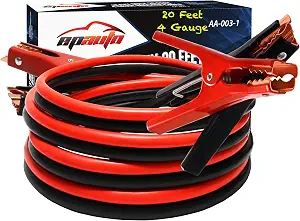
Not everybody needs 1-gauge cable.
For ordinary cars, crossovers and smaller SUVs, 4-gauge/20-foot cables can offer a much more sensible balance between capability, size and cost.
The EPAuto configuration includes 4-gauge, 20-foot cables with 500A positioning, copper-plated clamps, a travel bag and safety gloves.
Key Features
- 4-gauge cable
- 20-foot length
- 500A configuration
- Copper-plated clamps
- Tangle-free design
- Carrying bag
- Safety gloves included
Benefits
The 20-foot length is particularly useful because you don’t always have the luxury of placing two vehicles close together.
At the same time, 4-gauge cable avoids the extreme bulk associated with 1-gauge and 0-gauge cables.
For a family sedan or typical SUV, this can be the sweet spot for an emergency trunk kit.
Pros
- Excellent length
- Good balance of power and portability
- Includes useful accessories
- Suitable for many passenger vehicles
- Generally more affordable than heavy 1-gauge cables
Cons
- Not the first choice for very large diesel engines
- Less robust than 1- or 2-gauge options
- Copper-plated construction isn’t the same as a pure-copper premium cable
Who Is It Best For?
Best jumper cables for everyday cars, sedans, crossovers and moderate SUV use.
Why They’re Worth the Price
This is where spending more doesn’t necessarily mean buying the biggest cable available.
If your vehicle doesn’t require 1-gauge cable, paying substantially more for an oversized set may simply add weight and bulk without providing a meaningful advantage for your particular application.
Check the latest price and availability now before stock runs out
5. CARTMAN 4-Gauge 20-Foot Jumper Cables — Best for Everyday Drivers
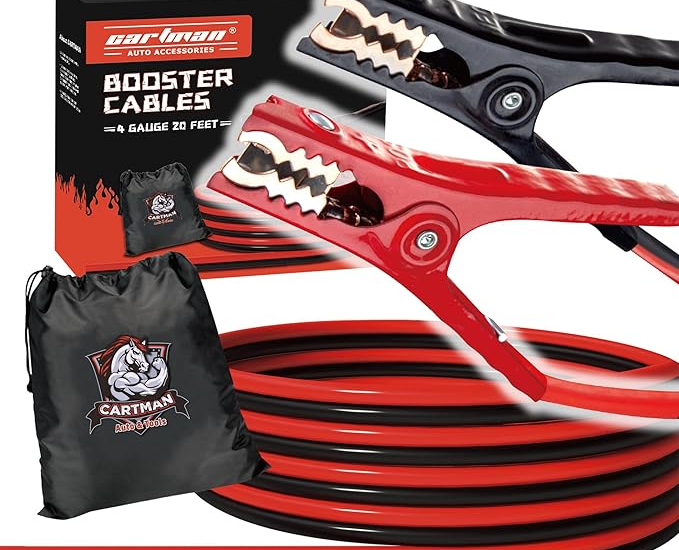
The CARTMAN 4-gauge/20-foot option is another practical choice for drivers who want longer-than-basic cables without carrying a massive professional-grade set.
CARTMAN’s current listings include 4-gauge/20-foot configurations as well as heavier 2- and 1-gauge versions. Its insulated clamp design is intended to work with both top- and side-post batteries.
Key Features
- 4-gauge cable
- 20-foot configuration
- Insulated clamps
- Anti-rust clamp design
- Tangle-resistant PVC
- Designed for cars, SUVs and pickups
- Carrying bag
Benefits
For most ordinary drivers, the key advantage is simplicity.
You get enough length for awkward roadside situations without stepping into the weight and storage requirements of extremely thick professional cables.
Pros
- Good all-around configuration
- 20-foot reach
- Insulated clamps
- Useful for top- and side-post batteries
- Good option for emergency kits
Cons
- Not the strongest choice for very large diesel engines
- Bulkier than short 10-foot cables
- CCA construction isn’t equivalent to pure copper
Who Is It Best For?
Best jumper cables for everyday drivers who want a dependable emergency set without going overboard.
Why They’re Worth the Price
For someone who drives a regular sedan, crossover or midsize SUV, this type of configuration often makes more sense than purchasing an extremely heavy professional cable.
Check the latest price and availability now before stock runs out
Jumper Cables Comparison: Which One Should You Buy?
| Feature | TOPDC 2-Gauge | TOPDC 1-Gauge | CARTMAN 1-Gauge | EPAuto 4-Gauge | CARTMAN 4-Gauge |
|---|---|---|---|---|---|
| Gauge | 2 AWG | 1 AWG | 1 AWG | 4 AWG | 4 AWG |
| Length | 20 ft | 25 ft | 20 ft | 20 ft | 20 ft |
| Best For | SUVs/trucks | Large trucks | Heavy-duty use | Cars/SUVs | Everyday driving |
| Portability | ⭐⭐⭐ | ⭐⭐ | ⭐⭐ | ⭐⭐⭐⭐ | ⭐⭐⭐⭐ |
| Heavy-duty capability | ⭐⭐⭐⭐⭐ | ⭐⭐⭐⭐⭐ | ⭐⭐⭐⭐⭐ | ⭐⭐⭐⭐ | ⭐⭐⭐⭐ |
| Long-distance reach | ⭐⭐⭐⭐ | ⭐⭐⭐⭐⭐ | ⭐⭐⭐⭐ | ⭐⭐⭐⭐ | ⭐⭐⭐⭐ |
| Best Value | ⭐⭐⭐⭐ | ⭐⭐⭐ | ⭐⭐⭐ | ⭐⭐⭐⭐⭐ | ⭐⭐⭐⭐ |
What to Look for Before Buying Jumper Cables
Buying jumper cables isn’t simply about finding the biggest amp number printed on the package.
There are several factors that matter more.
1. Cable Gauge
This is one of the most important specifications.
Lower AWG = thicker cable.
Typical recommendations include:
- 6-gauge: smaller cars and light-duty applications
- 4-gauge: passenger vehicles, SUVs and light trucks
- 2-gauge: large SUVs, pickups and demanding applications
- 1-gauge: large engines and diesel applications
- 0/1-0 gauge: extremely heavy-duty/professional applications
Car and Driver similarly notes that 4- or 6-gauge cables are generally appropriate for standard vehicles, while 1- or 2-gauge cables make more sense for full-size trucks and vans.
Don’t Automatically Buy the Thickest Cable
A thicker cable isn’t automatically “better” for every driver.
A 1-gauge cable can be heavy, stiff and difficult to store. If you drive a small sedan, a quality 4-gauge cable may be the smarter purchase.
2. Cable Length
Length is another important consideration.
A 12–20-foot cable is generally a practical range for roadside use, while 25-foot cables offer additional flexibility when vehicles cannot be parked close together.
Short Cables
Advantages:
- Easier to store
- Lighter
- Less expensive
- Less resistance
Disadvantages:
- Vehicles must be parked close together
- Difficult in awkward parking situations
Long Cables
Advantages:
- More flexible
- Easier when batteries are located far apart
- Useful for trucks and roadside assistance
Disadvantages:
- Heavier
- More difficult to store
- Greater electrical resistance over the longer run
This is why long + thin is a combination to avoid. A longer cable should generally have a sufficiently thick conductor to compensate for increased resistance.
3. Copper vs. CCA
This is an important specification that many shoppers overlook.
There is a major difference between:
Pure copper
and
Copper-clad aluminum (CCA).
Copper has significantly higher electrical conductivity than aluminum. CCA can reduce weight and manufacturing cost, but a cable’s gauge designation alone doesn’t tell you the complete story about its real electrical performance.
If you are building a professional-grade emergency kit, pay close attention to the actual conductor material rather than choosing solely by the advertised amp rating.
4. Clamp Quality
The clamps are just as important as the cable.
Look for:
- Strong spring tension
- Large contact area
- Good insulation
- Secure cable connection
- Corrosion-resistant construction
- Adequate jaw opening
A high-quality cable with a poor clamp connection can still perform badly because the connection itself introduces resistance.
5. Insulation and Cold-Weather Flexibility
Cheap jumper cables can become extremely stiff in cold weather.
Look for a flexible outer jacket that remains manageable in low temperatures.
This matters particularly if the cables are permanently stored in your vehicle.
A cable that becomes hard and brittle after repeated temperature changes is not something you want to discover during a roadside emergency.
6. Storage Bag
It may seem like a minor feature, but a carrying case is surprisingly useful.
A good bag:
- Keeps the cables organized
- Prevents tangling
- Protects the cables
- Keeps your trunk cleaner
- Makes emergency equipment easier to locate
If you keep several emergency items in your vehicle, organization becomes much more important.
Budget vs. Premium Jumper Cables: Is More Expensive Really Better?
Here’s where shoppers need to be careful.
More expensive does not automatically mean better.
A $20 cable isn’t necessarily useless, and a $100 cable isn’t automatically superior.
The real question is:
What are you paying extra for?
Premium pricing can be justified when it provides:
- Thicker conductors
- Longer usable length
- Better clamps
- Better insulation
- Higher durability
- Better cold-weather flexibility
- Better storage
- More appropriate construction for large engines
- More reliable connections
For example, a 4-gauge/20-foot cable can be an excellent choice for a normal family vehicle.
But if you’re trying to jump-start a large diesel truck with a long cable, stepping up to 2-gauge or 1-gauge can make considerably more sense.
The Best Long-Term Value
Instead of asking:
“What’s the most expensive jumper cable?”
ask:
“What’s the highest-quality cable that matches my vehicle?”
That’s the approach that usually produces the best value.
Best Jumper Cables for Different Vehicles
Best Jumper Cables for a Small Car
Look for:
4–6 gauge / 16–20 feet
You don’t necessarily need an enormous 1-gauge cable.
Best Jumper Cables for an SUV
Look for:
2–4 gauge / approximately 20 feet
This gives you a useful balance between current capacity and portability.
Best Jumper Cables for a Pickup Truck
Look for:
1–2 gauge / 20–25 feet
The extra thickness and length provide more flexibility.
Best Jumper Cables for Diesel Trucks
Look toward:
1-gauge or 0-gauge / 20–30 feet
Diesel engines can demand substantially more starting power, making heavier-duty cables more appropriate.
Best Jumper Cables for Roadside Assistance
Prioritize:
2-gauge or 1-gauge + 20–25 feet
If you’re helping other motorists, you don’t know what type of vehicle you’ll encounter.
That’s when buying a more versatile heavy-duty set becomes much easier to justify.
Jumper Cables vs. Portable Jump Starter
Another question buyers often ask is:
Should I buy jumper cables or a portable jump starter?
They aren’t exactly the same tool.
Jumper Cables
You need:
- A second vehicle
- A functioning battery
- Correct cable connection
- Safe positioning of both vehicles
The advantage is simplicity: good jumper cables don’t need to be charged or maintained like a battery-powered jump starter.
Portable Jump Starter
A modern jump starter can start a vehicle without another car.
That makes it much more convenient for solo drivers.
However, you have to keep the unit charged and make sure its battery remains healthy.
For a serious emergency kit, owning both can actually make sense.
Safety: How to Use Jumper Cables Correctly
Jumper cables carry very high current, so mistakes can cause sparks, electrical damage or injury.
Before connecting anything:
- Read the vehicle owner’s manual.
- Make sure both vehicles use compatible electrical systems.
- Inspect the cables for damage.
- Do not use cables with exposed conductors.
- Keep clamps from touching each other.
- Make sure vehicles are positioned safely.
- Identify the correct positive and negative terminals or designated jump points.
A typical jump-start procedure involves connecting the positive terminals first, followed by the negative connection and an appropriate ground point, but your vehicle manufacturer’s instructions take priority.
Modern vehicles can contain sensitive electronics, so never assume every vehicle should be connected identically.
MotorTrend specifically warns that incorrect connections can damage vehicle electronics and recommends paying attention to features such as clamp design and polarity protection.
If you’re uncertain about the connection procedure for your specific vehicle, consult the owner’s manual or a qualified mechanic rather than experimenting.
Real-World Scenarios Where Good Jumper Cables Matter
Scenario 1: Dead Battery at Home
You have a sedan that won’t start after sitting for several days.
A quality 4-gauge/20-foot cable is more than adequate for many ordinary vehicles.
Best choice: EPAuto or CARTMAN 4-gauge.
Scenario 2: Dead Battery in a Pickup
You’re driving a full-size pickup and another vehicle is available to help.
The vehicles can’t be positioned perfectly.
A 20-foot 2-gauge cable gives you additional flexibility.
Best choice: TOPDC 2-gauge.
Scenario 3: Diesel Truck
You operate a large diesel vehicle and want cables specifically for demanding emergency starts.
This is where going substantially thicker makes more sense.
Best choice: TOPDC 1-gauge or CARTMAN 1-gauge.
Scenario 4: Helping Other Drivers
If you regularly carry emergency equipment and might need to assist different types of vehicles, versatility becomes more valuable than minimum size.
Best choice: a 1- or 2-gauge heavy-duty set.
Are Expensive Jumper Cables Worth It?
Sometimes — but only when the additional cost buys meaningful improvements.
For a small passenger car, spending heavily on oversized cables isn’t necessarily smart.
For a truck owner, DIY mechanic, fleet operator or driver who frequently travels remote routes, however, buying a robust set once can be much better than discovering that a cheap cable is too thin, too short or too stiff when you need it.
The key is matching:
Gauge + length + conductor material + clamp quality + intended vehicle
rather than simply chasing the highest advertised amperage.
Final Verdict – Best Overall Choice
🏆 Best Overall: TOPDC 2-Gauge 20-Foot Jumper Cables
For most drivers who want a serious upgrade from basic emergency cables, TOPDC’s 2-gauge/20-foot configuration is my overall pick.
It strikes the right balance between:
- Heavy-duty capability
- Useful length
- Vehicle compatibility
- Emergency versatility
- Reasonable portability
TOPDC itself currently identifies the 2-gauge/20-foot configuration as its all-around recommendation, particularly for SUVs and pickups.
Check the latest price and availability now before stock runs out
🥇 Best Value: EPAuto 4-Gauge 20-Foot
If you’re driving a regular car, crossover or moderate SUV and don’t need professional-grade cables, EPAuto 4-gauge/20-foot is the more economical choice.
The combination of 20-foot reach, 4-gauge construction, clamps, storage bag and included gloves makes it a practical emergency-kit option.
Check the latest price and availability now before stock runs out
🏆 Best Premium: TOPDC 1-Gauge 25-Foot
For drivers who prioritize maximum reach and heavy-duty capability, the 1-gauge/25-foot TOPDC configuration is the standout premium choice.
It’s especially compelling for:
- Pickup trucks
- Large SUVs
- Diesel vehicles
- RVs
- Commercial vehicles
- Roadside assistance
- Drivers who regularly help other motorists
Check the latest price and availability now before stock runs out
Frequently Asked Questions
What gauge jumper cables are best?
For many ordinary vehicles, 4- or 6-gauge cables are appropriate. Larger trucks and vans can benefit from 1- or 2-gauge cables. Diesel engines generally call for heavier-duty cables.
Are 4-gauge jumper cables good enough?
For many passenger cars, SUVs and light trucks, yes. A quality 4-gauge cable around 16–20 feet can provide an excellent balance of capability and portability.
Are thicker jumper cables better?
Not automatically. Thicker cables can carry more current and are advantageous for larger engines, but they’re heavier, bulkier and more expensive.
Is 20 feet too long for jumper cables?
No. Twenty feet is a very practical length because it allows greater flexibility when the donor vehicle cannot be positioned directly next to the disabled vehicle.
Are 25-foot jumper cables better than 20-foot cables?
Only if you actually need the additional reach. A 25-foot cable provides more positioning flexibility, but longer cables also add weight, storage requirements and electrical resistance.
What is better: copper or CCA jumper cables?
Pure copper generally offers better electrical conductivity than copper-clad aluminum. However, CCA cables can be perfectly adequate when appropriately sized for the intended application. Don’t judge a cable solely by its AWG number.
Can I use jumper cables on a diesel truck?
You can use jumper cables designed for the vehicle’s electrical system, but diesel engines generally benefit from heavier-gauge cables because of their higher starting demands.
Should I keep jumper cables in my car?
Absolutely. A quality set takes up relatively little space compared with the inconvenience of being stranded with a dead battery.
For frequent travelers, a complete roadside emergency kit can be even better because it can combine jumper cables with items such as a flashlight, tire inflator, reflective equipment and basic tools.
Bottom Line
The best jumper cables on Amazon aren’t necessarily the most expensive ones.
For most drivers, a quality 4-gauge or 2-gauge cable around 20 feet offers the best combination of power, reach and practicality.
For trucks, diesel engines and demanding roadside use, moving up to 1-gauge or even 0-gauge can be a worthwhile investment.
If I had to choose only one configuration for a versatile emergency kit, I’d choose a 2-gauge, 20-foot heavy-duty set. It provides substantially more capability than thin budget cables without becoming as cumbersome as the largest professional sets.
Choose the gauge based on your vehicle, choose the length based on your real-world parking situations, and pay close attention to the clamps and conductor material.


2 comments
Я узнал о [url=https://photorazdevator.live/]раздели девушку тг[/url] и удивился возможностям нейросетей.
Прозрачность в обучении моделей и доступ к аудиту алгоритмов уменьшают вероятность злоупотреблений.
Также обсуждаются вопросы предвзятости моделей, когда ошибки чаще происходят для представителей определённых групп.
Been playing at true fortune casino about six months back when a lad from my footy group banged on about it, and not gonna lie I assumed it’d be another one of those cookie-cutter sites that go quiet after a month. Still logging in though, so take that as you will.
The library’s genuinely big — they claim over 2,500 slots and tables last I looked. Pragmatic Play dominate the front page, so there’s the usual suspects — Sweet Bonanza gets the bulk of my spins, and I’ve had decent runs on Big Time Gaming titles too. Evolution classics are buried a bit but you can find them.
Live section is basically Evolution by the looks of it, and that’s the standard these days. Crazy Time and Monopoly Live get a fair few players in the evenings, dealers are real and chatty and it doesn’t stutter on home broadband. Sign-up offers is a match up to ?500 with 50 spins on selected slots, playthrough sits at 35x which isn’t amazing but isn’t a scam either. I got a small no deposit thing during a promo week too; the promos shift monthly so it’s worth a check what’s live at [url=https://innerlighthouseapp.com/]true fortune[/url] rather than trusting my memory.
You can get in from a tenner last time I topped up, verification took two minutes plus KYC. Visa works fine, Neteller are there and Bitcoin’s an option too for anyone who prefers it. Withdrawals on my card took about 24 hours, bank transfer dragged to three days.
My main gripe: KYC got asked for twice, which held up a ?200 cashout by a couple of days. The chat team sorted it but I had to repeat myself. Licensing-wise it’s and that mattered to me, so it’s the first thing I check now.
They don’t have an app on the Play Store, the responsive site does the job — runs smooth on Android, although the filters are fiddly on a small screen. I’ve not moved on, which is the honest answer.